
Timelapse Cinematography: What Capturing a Full Moon Over a Mountain Teaches You About Patience and Craft
Timelapse photography is one of the few cinematographic techniques that requires you to commit completely before you know what you’ll get. You set the camera, you calculate the interval, you orient the frame and then you wait. Sometimes for hours. The moon rises or it doesn’t. The clouds clear or they don’t. The light does something extraordinary or it’s flat. You don’t find out until you’re already there.
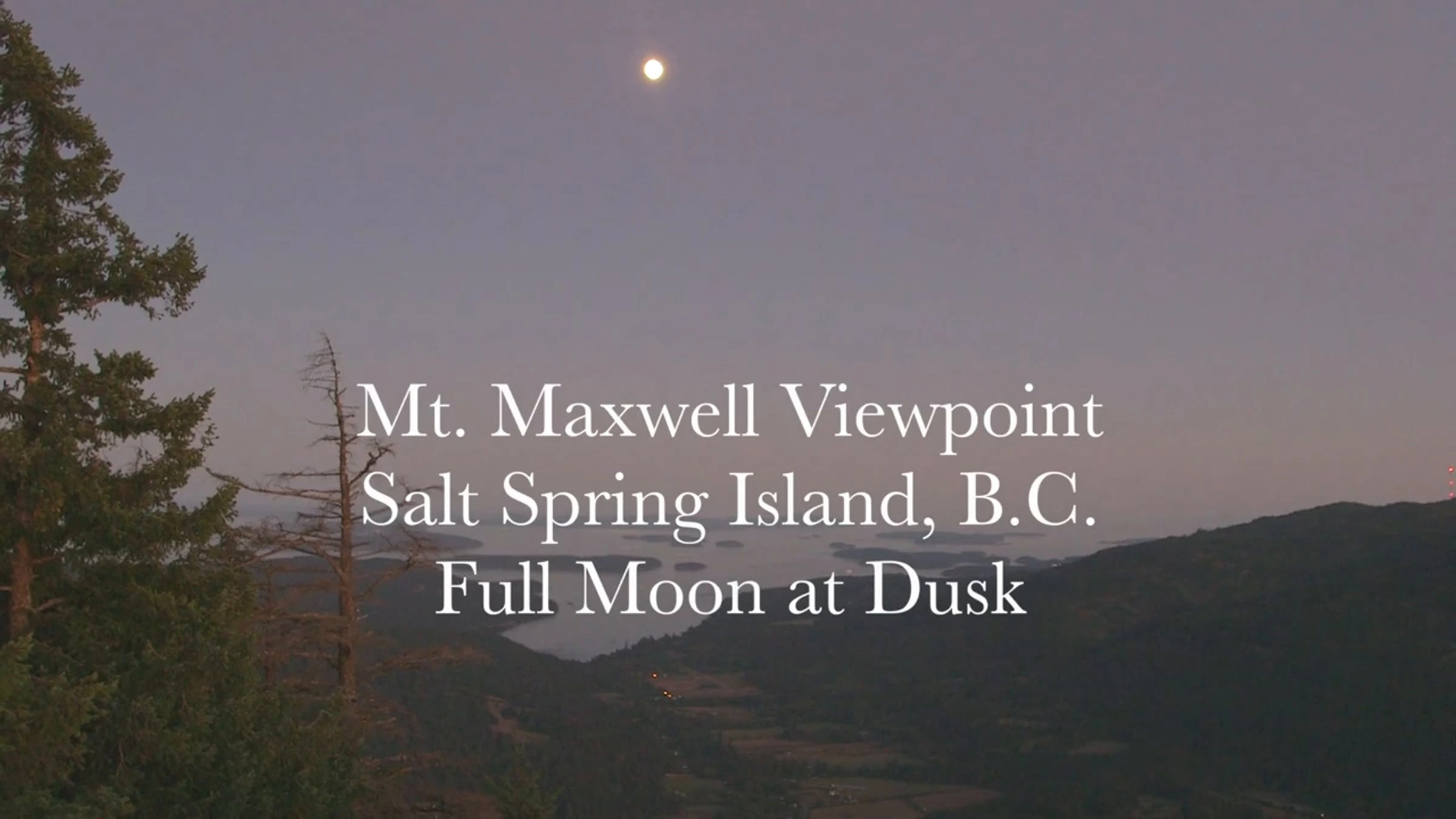
The Full Moon over Mount Maxwell timelapse shot at the viewpoint on top of Mount Maxwell on Salt Spring Island, British Columbia is that kind of work. A location scouted in advance. A night chosen for the lunar cycle. A camera positioned to capture the arc of a full moon rising over a landscape that, at that particular moment, was worth capturing.
No client asked for this. No brief specified the shot. It’s what a cinematographer does when the only thing driving the decision is whether something is worth seeing.
What timelapse requires that other cinematographic techniques don’t
Most cinematographic work happens in real time or close to it. The camera moves, the subject moves, the editor shapes the timing after the fact. Timelapse inverts that relationship: the timing is built into the capture itself, through the interval between frames, and cannot be substantially changed in post without introducing artifacts that compromise the footage.
That means every significant decision has to be made before the shutter opens for the first time.
The interval calculation. The time between frames determines the relationship between real elapsed time and the compressed duration of the final clip. A full moon rising over a mountain over the course of two hours needs a different interval calculation than a sunset, a storm system, or a crowd filling a plaza, because each subject moves at a different speed and needs a different compression ratio to look right on screen. Getting this wrong produces footage that either moves too fast to read or too slowly to feel like timelapse at all.
The composition has to account for movement through the frame. A static subject can be composed based on where it is. A moving subject, a rising moon, a rotating star field, a building cloud formation — has to be composed based on where it will be across the full arc of its movement. A frame that looks perfect when the moon is on the horizon may look wrong when it reaches the center of the sky, and the whole clip has to work as a continuous sequence, not just as individual frames.
Light changes in ways that require planning for, not responding to. The exposure difference between a dark horizon and a bright full moon high in the sky is significant. Timelapse sequences that don’t account for this produce footage that either blows out as the moon rises or goes dark as the sky brightens. Exposure ramping, gradually adjusting the camera settings during the capture to track the changing light, is the technique that handles this, and it has to be set up correctly before the sequence begins.
You cannot stop and start. A timelapse sequence is a continuous document. Any interruption, a camera bumped, a battery changed in the middle, a card swapped creates a break in the sequence that may be unusable. Everything that needs to be ready has to be ready before the first frame is captured.
What astronomical and night sky cinematography adds to a DP’s toolkit
Night sky cinematography moonrises, star trails, the Milky Way, aurora occupies a specific place in a cinematographer’s technical development. The techniques it requires are different from daylight production in almost every respect, and mastering them builds capabilities that transfer directly to challenging production contexts where light is limited, unpredictable, or technically demanding.
Low-light sensitivity and noise management. Shooting at night requires working at the edges of what a camera sensor can do cleanly. Understanding how to manage noise, how to select the right ISO for a specific sensor in a specific condition, and how to balance the trade-off between exposure and image quality in low light is knowledge that matters whenever a production encounters difficult lighting conditions.
Patience as a professional discipline. Night sky work requires the willingness to set up, wait, and let the scene develop often for hours, without the option to intervene once the capture is running. That patience, and the planning required to make good use of a long wait, is a quality that shows up in commercial production contexts in how a cinematographer handles setups that don’t go according to plan.
Understanding light as a subject rather than a tool. In most commercial production, light is something you build and control. In night sky cinematography, the available light is the subject and working with it rather than against it develops a different and more fundamental understanding of what light actually does, how it changes, and how to see it rather than just manage it.
Salt Spring Island and the value of location
Mount Maxwell on Salt Spring Island is a specific choice, not a generic landscape. The island sits in the Salish Sea between Vancouver Island and the British Columbia mainland dark enough at night to show the sky clearly, elevated enough at the Maxwell summit to show the horizon over the surrounding water and islands.
The decision to be there, at that time, for that lunar cycle reflects something about how a cinematographer develops their eye: through the accumulation of decisions about where to be and when, driven by genuine curiosity about what a particular place looks like at a particular moment. That curiosity isn’t separate from professional craft. It’s where professional craft comes from.
What personal work like this communicates to a prospective client
The timelapse work, Wild Horses in New Mexico, Full Moon over Mount Maxwell, tells a prospective client something that a client portfolio can’t fully convey on its own: that the person behind the camera is genuinely interested in what the world looks like, independent of whether anyone is paying them to look.
That quality of attention curiosity that isn’t dependent on a brief is what produces the unexpected frame, the moment the camera catches that nobody planned for, the visual decision that elevates a commercial production from competent to memorable. It’s not something that can be acquired by studying technique alone. It comes from spending time with a camera in the world, for its own sake.
For a client evaluating whether to hire a production company, a portfolio of personal work alongside client work is an invitation to see who the people actually are not just what they can do when someone else defines the problem.
How Realist Films’ personal work connects to commercial capability
The timelapse discipline visible in the Mount Maxwell piece the interval planning, the exposure ramping, the patience of a multi-hour capture in a remote location translates directly into the timelapse production work Realist Films brings to commercial contexts: the USRC SRDRS mobilization documentation, drone production in demanding natural environments, and any commercial project where capturing something that unfolds over time requires technical preparation and the willingness to wait for it.
Personal work and commercial work aren’t separate categories. They’re the same eye, working on different problems, building the same capability over time.
Looking for a production partner whose technical discipline and genuine curiosity show up in every project?
Let’s talk about what that looks like for yours.


